An Article for New Academic Textbook Authors

Every Textbook Is a House. Build the Structure Before You Decorate the Rooms.

A practical framework for first-time authors: six elements that separate a textbook that merely gets published from one that actually teaches — organised the way an architect organises a building, structure first, style second.

Illustration of a house split between an architectural blueprint on one side and a warm furnished interior on the other, representing structure versus design
The Core Analogy

A House Has Two Halves

Every house — and every textbook — is really two separate projects layered on top of each other. Confusing them, or getting their order wrong, is the single most common mistake new authors make.

Structural Elements

Fixed once built. Expensive and disruptive to change afterward. Determined before a single brick is laid.

  • Number of floors, rooms, toilets
  • Blueprint of each floor — where load-bearing walls sit
  • Where the toilets are placed (second floor, for an elderly household, is a structural failure — not a decorating problem)

Interior Design Elements

Changeable long after move-in. Visible immediately, and drives daily joy — but never fixes bad bones.

  • Colour combinations, room themes
  • Wood versus glass tabletops
  • Floor and wall coverings, fabric versus leather
Beautiful interior design cannot rescue a bad structure — it just makes the suffering compound quietly, until the occupants (or students) eventually leave the house altogether. And a house with sound structure but flat interior design is serviceable, never joyful. Great textbooks need both halves right, in the right order.
Part One · The Fixed Structure

The Four Structural Elements

These are the "bricks and mortar" of a textbook. Get these wrong, and no amount of good writing, colour, or clever call-outs will save the book — students and teachers will eventually abandon it, the same way a family abandons a house with the only bathroom on the wrong floor.

1
Structural Element

The Curriculum

Illustration of a notebook transitioning from broad curriculum philosophy notes to a precise numbered syllabus checklist

The curriculum is the word-based, descriptive account of what the book teaches — the philosophy, scope, and rationale behind the subject, before it is broken into examinable pieces. It answers "what kind of understanding are we building, and why does this subject matter to this learner at this stage?"

This is the equivalent of the architect's brief: how many storeys, what is this house for (a family home, a rental, a retirement bungalow), before anyone draws a single wall. Skipping this step and jumping straight to a list of testable objectives produces a technically compliant but soulless book.

  • State the subject's purpose and the type of thinking it should develop (e.g. scientific reasoning versus rote recall)
  • Identify the intended learner profile — age, prior knowledge, language proficiency
  • Describe how this subject connects to the subjects before and after it in the learner's journey
Example A national curriculum document for secondary Chemistry might state: "Students should develop the ability to reason about matter at the particulate level, and to design and evaluate experiments" — long before any exam board turns this into a numbered list of assessable statements.
2
Structural Element

The Syllabus

The syllabus is the specific, examinable list of learning objectives the book must cover — the numbered statements that appear on an exam board's specification, each one a contractual promise to the learner and the teacher. Unlike the curriculum, the syllabus is precise, finite, and traceable: every learning objective (LO) should be locatable in the book, and every page should trace back to an LO.

This is the room count and the plumbing schedule of the house: exact, numbered, and non-negotiable. An author who "roughly covers" the syllabus, the way a builder who "roughly plumbs" a bathroom, will fail the inspection — in this case, the exam.

  • Extract the verbatim wording of every LO from the official specification — never paraphrase the command word
  • Build a coverage matrix mapping every LO to a specific chapter, page, and assessment item
  • Flag command-word level (state, describe, explain, evaluate) since it determines depth of treatment, not just topic presence
Author's discipline Before writing a single chapter, produce a spreadsheet with one row per LO and a column confirming exactly where it is taught and where it is assessed. If a row is empty, that is a structural hole — the equivalent of a house plan missing a bathroom.
3
Structural Element

Physical Layout

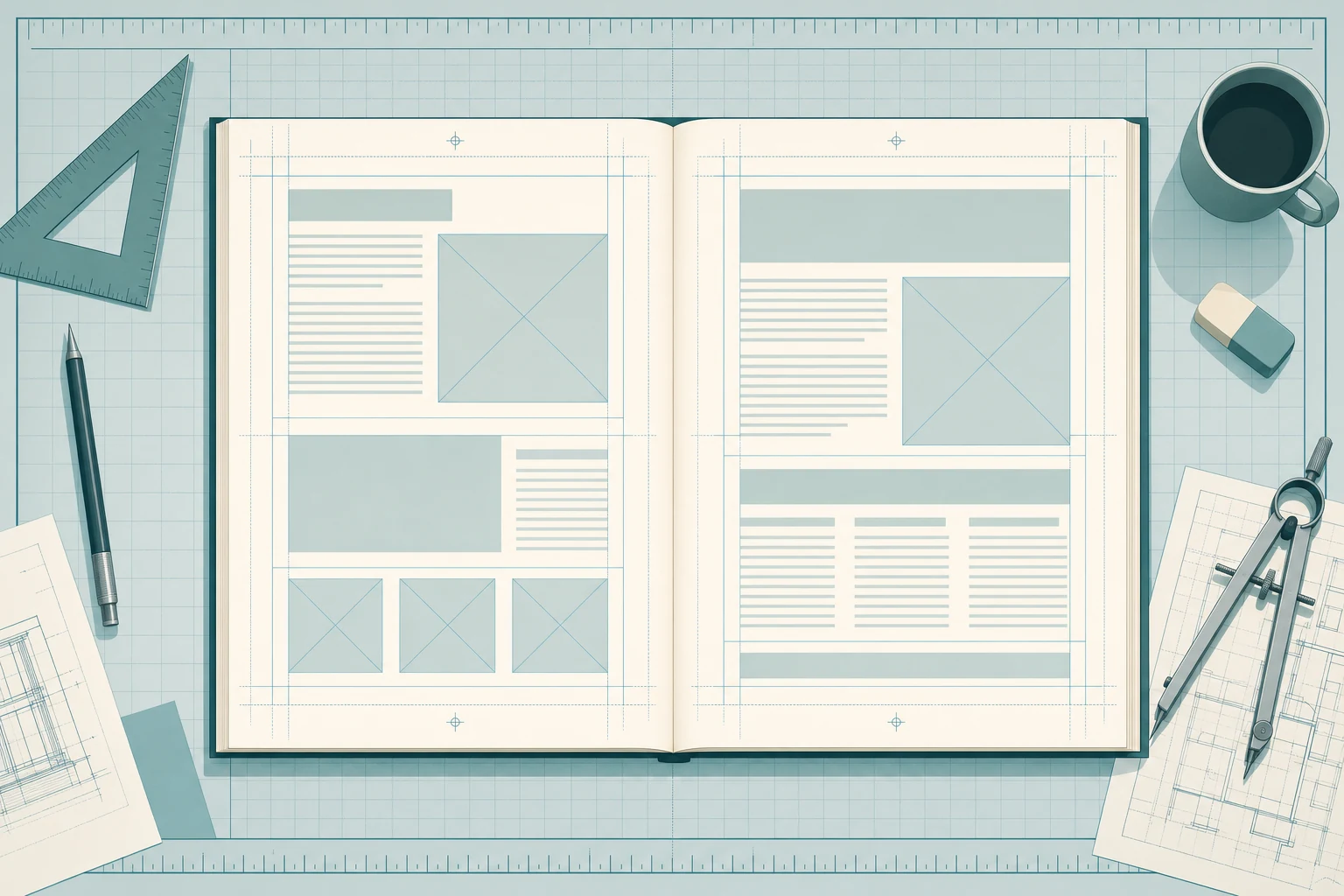
Illustration of a textbook page-layout grid with margin guides and placeholder text and image blocks

Physical layout is the page-level architecture of the book: trim size, margin widths, column structure, where images sit relative to text, how much white space surrounds a worked example. It is fixed early because retrofitting layout after 300 pages are written is enormously expensive — the equivalent of moving a load-bearing wall after the house is furnished.

Layout decisions are invisible to most readers until they are wrong: text that runs too wide to read comfortably, diagrams separated from their captions by a page turn, or dense walls of text with no visual rest.

  • Fix trim size and grid (single vs. two-column) before drafting begins, not after
  • Decide the ratio of text to white space to image per spread, and hold that ratio consistently
  • Define where marginal notes, vocabulary boxes, and answer spaces live on the page, once, for the whole book
Why this is structural, not decorative Changing the font colour of a call-out box later is trivial. Changing from a two-column to a single-column grid after 200 pages are typeset means re-flowing the entire book. Layout is a foundation decision wearing a design-looking costume.
4
Structural Element

Book Structure & Chapter Blueprint

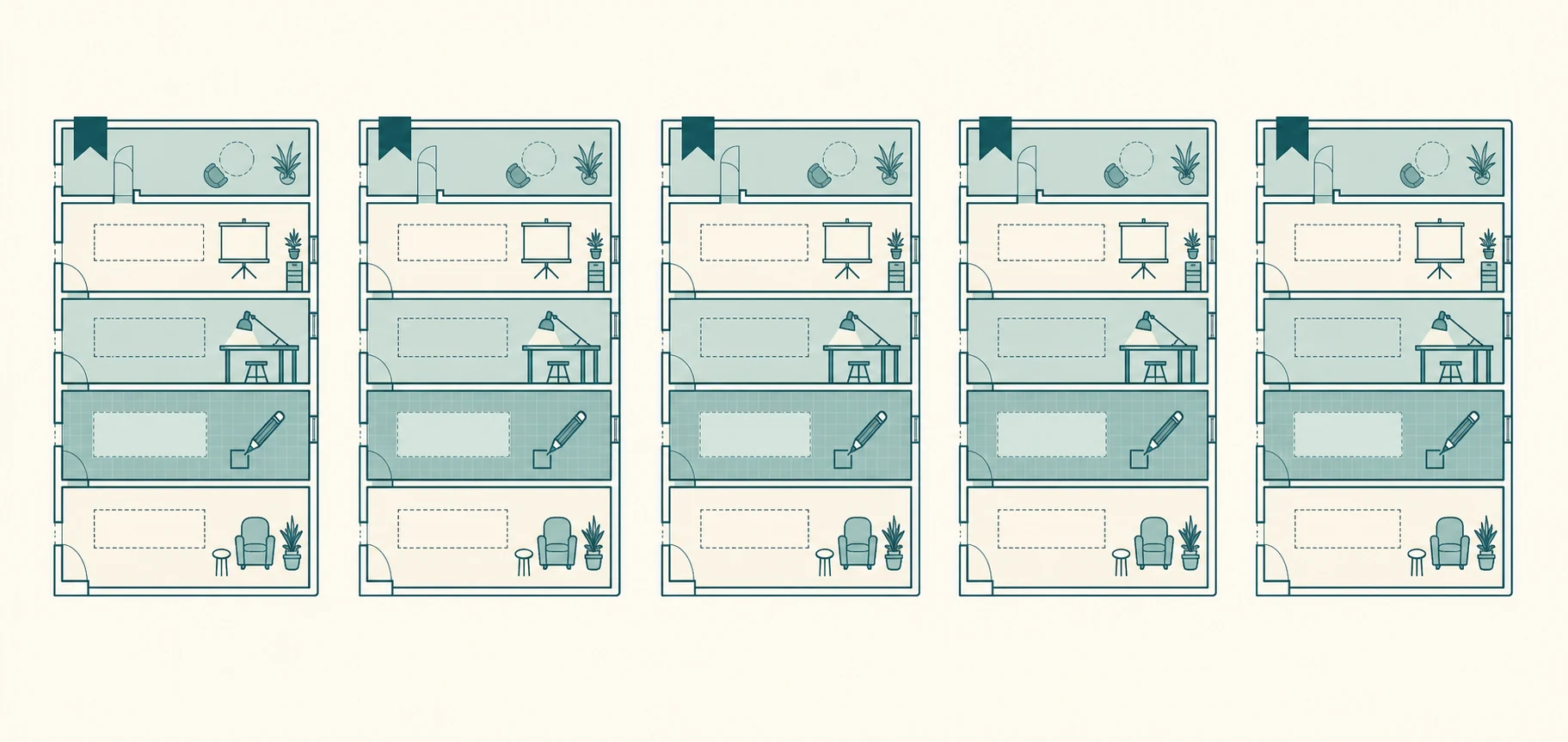
Illustration of five identical chapter icons each subdivided into the same repeatable internal sections

This is the blueprint of the whole house — the table of contents, the sequencing of chapters, and, critically, the repeating internal architecture that every chapter follows: does each chapter open with a hook, move through explanation, worked examples, guided practice, and end with independent practice and a summary? Once chosen, this skeleton should repeat with near-total consistency across every chapter in the book.

A book where Chapter 3 has worked examples before explanation, and Chapter 7 has none at all, is a house where some floors have staircases and others don't. Consistency of structure is what lets a student navigate the book on their own by Chapter 4, without re-learning "how this book works" every time.

Two functions belong inside this blueprint that authors frequently overlook because they feel like "content" rather than "structure." First, every chapter must open by activating prerequisite knowledge — a short retrieval of what the learner already knows and needs, before new material is introduced. Skipping this is the equivalent of building the second floor before checking the first floor's foundation can bear the load; students without secure prior knowledge will silently fail to absorb what follows. Second, the blueprint must fix where retrieval practice, formative assessment, and summative assessment sit within and across chapters — not as an afterthought bolted onto the end, but as load-bearing fixtures placed at specific points in every chapter, just as consistently as the worked-example section is placed.

  • Design one repeatable chapter template (the "floor plan") before writing chapter one
  • Sequence chapters by cognitive dependency, not by convenience or alphabetical order
  • Decide chapter length and sub-topic count as a fixed rule, then apply it uniformly
  • Fix a "prerequisite activation" moment at the start of every chapter, so no chapter assumes silently-recalled knowledge
  • Fix where retrieval-practice checkpoints, formative checks, and end-of-chapter summative assessments recur, and hold that placement constant across every chapter
A useful test Photocopy the first page of five different chapters with the chapter titles blacked out. If a reader can't tell they are looking at "the same book," the chapter blueprint is not yet a real structure — it is an accident repeated five times. Apply the same test to the last page: can you find the retrieval and assessment checkpoints in the same relative position in all five?
Part Two · The Changeable Interior

The Two Interior Design Elements

Once the structure is sound, interior design is where the book comes alive for the reader. These choices are far easier to revise later — but they are also what determines whether students actually enjoy opening the book each day.

5
Design Element

Pedagogical Style

Illustration of a storybook character walking into a page of directive numbered instructions, representing narrative versus directive teaching style

Pedagogical style is the voice, posture, and instructional approach the book takes toward the learner. This covers more ground than voice alone: it is narrative versus directive versus guided-inquiry versus mastery-based, it is the reading level the prose is pitched at, and it is how much cognitive load the page places on the learner at any one moment. This is analogous to a room's theme: a nautical bedroom versus a minimalist one — both are structurally identical bedrooms, but they feel entirely different to live in.

Pedagogical style should be chosen deliberately for the age band, subject, and instructional goal, not defaulted to whatever the author finds easiest to write. Beyond the narrative/directive axis, authors should consider approaches such as guided inquiry (the learner discovers a concept through structured questioning before being told the rule) and mastery-based pedagogy (the learner must demonstrate command of one concept before advancing, with built-in re-teaching loops for those who don't). These are not merely different tones of voice — they change what the page must contain and in what order.

DimensionNarrativeDirectiveGuided InquiryMastery-Based
VoiceThird-person story, recurring charactersSecond-person, "you," direct addressQuestion-led, Socratic promptsSecond-person with explicit checkpoints
Best fitPrimary language arts, younger learnersUpper-secondary sciences, exam-focused subjectsSciences and maths where discovery builds intuitionSkill-based subjects with clear progression (maths, coding, language)
Risk if overusedSlows down dense technical contentFeels cold or demotivating for young childrenCan frustrate learners needing more scaffoldingCan feel repetitive without narrative variety

Two further decisions belong here, and are frequently left unstated by first-time authors. First, cognitive load: pedagogical style determines how much new information, vocabulary, and visual complexity appears on a page at once — a narrative style with rich description can unintentionally overload working memory just as easily as a directive style with too many steps crammed into one paragraph. Second, reading level: the book's vocabulary range, sentence length, and syntactic complexity should be explicitly defined and held constant for the target age band, rather than drifting upward as the author's own writing style takes over in later chapters.

Practical rule Pick one dominant instructional approach and voice per book and apply it with near-total consistency. Alongside it, write down the target reading level (e.g., Lexile band or equivalent) and a stated cognitive-load ceiling (e.g., no more than one new concept and three new vocabulary terms per page), and check every chapter against both before it is considered complete.

6
Design Element

Call-Outs

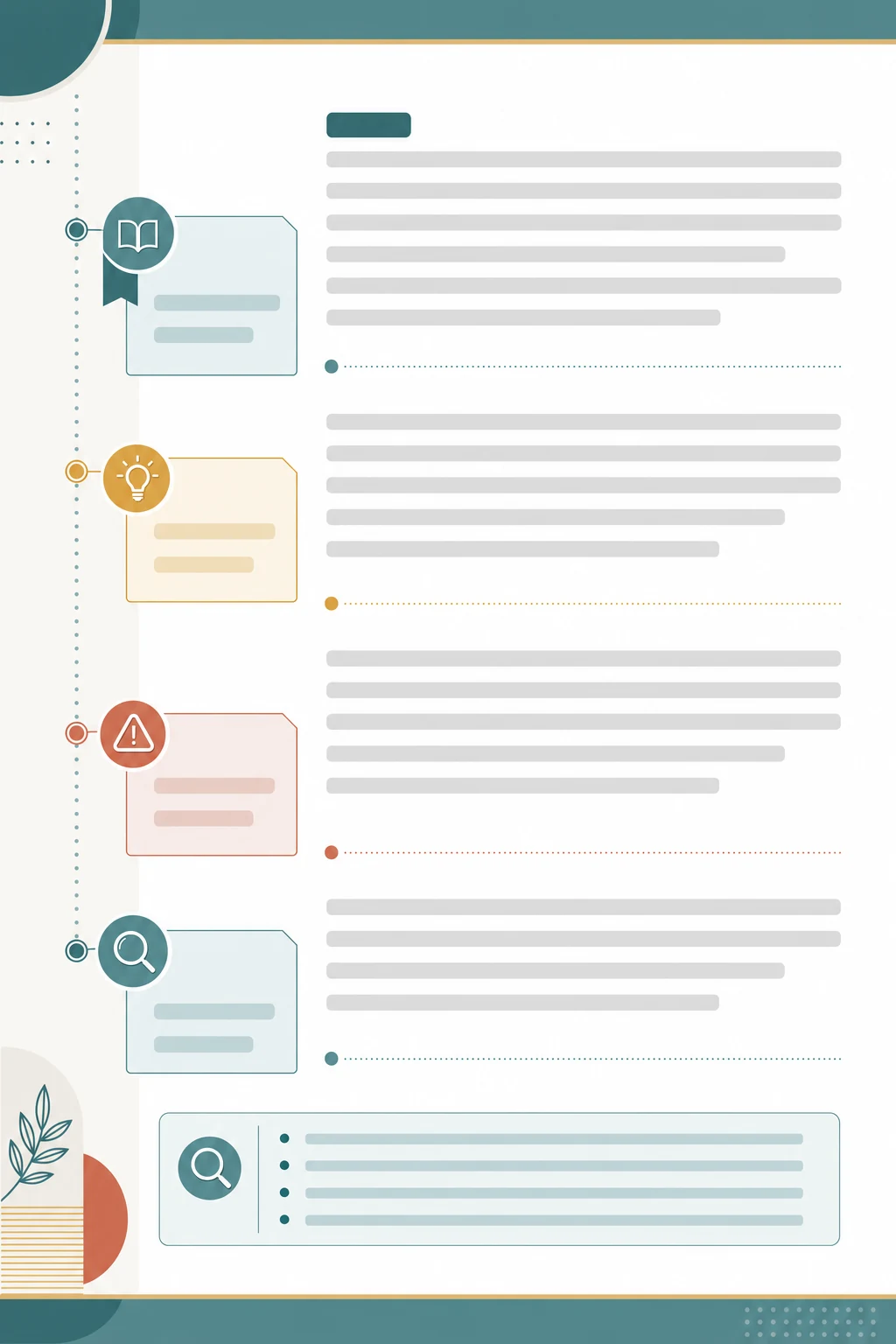
Illustration of textbook margin call-out icons including vocabulary highlight, real-life example, common mistake warning, and try-this prompt

Call-outs are the recurring visual and textual devices that break up the page and draw attention to something specific: highlighted new vocabulary, real-life application boxes, common-mistake warnings, "try this" prompts, or safety notes. These are the fabric, the tabletop, the wall colour of the book — small, repeated choices that shape the daily experience of reading it.

The two questions every author must answer here: which call-out types will this book use, and how disciplined will their use be? A book with too many call-out types becomes visually noisy; a book with none feels flat and undifferentiated, like unfurnished rooms.

  • Choose 3-5 call-out types maximum and give each a fixed visual identity (icon, colour, label)
  • Decide explicitly: will new vocabulary be highlighted inline, boxed, or glossed in the margin?
  • Decide whether real-life application examples appear every sub-topic, every chapter, or only where naturally strong

Common call-out types

New word / vocabulary box, real-life example, common mistake warning, "try this" activity, safety note, exam tip, fun fact / curiosity prompt.

Discipline over novelty

A call-out that appears inconsistently trains readers to ignore it. Consistency of placement and appearance matters more than cleverness of design.

Putting It Together

The Author's Build Sequence

Just as no builder decorates a room before pouring the foundation, no textbook author should lock in pedagogical style or call-outs before the four structural elements are settled. This is the order that avoids expensive rework.

1. Write the curriculum statement

Settle the purpose, learner profile, and philosophy of the subject in prose, before touching any specification document.

2. Extract and map the syllabus

Build the LO coverage matrix against the official specification. This becomes the single source of truth for what must appear, and where.

3. Fix the physical layout

Choose trim size, grid, and the text-to-white-space-to-image ratio. Lock this before a single chapter is drafted in full.

4. Design the chapter blueprint

Build one repeatable chapter template and pilot it on a single chapter before committing to the whole book.

5. Choose the pedagogical style

Decide narrative versus directive, matched to the age band and subject, and confirm it against the piloted chapter.

6. Define the call-out system

Select a small, disciplined set of call-out types and apply them consistently from the first chapter onward.

✦ ✦ ✦

Structure First. Style Second. Every Time.

A textbook author who can clearly specify these six elements before writing a full draft has already solved most of the problems that sink first-time books — regardless of subject, grade level, or exam board.